
Real-time agentic crew scheduling, with humans in control
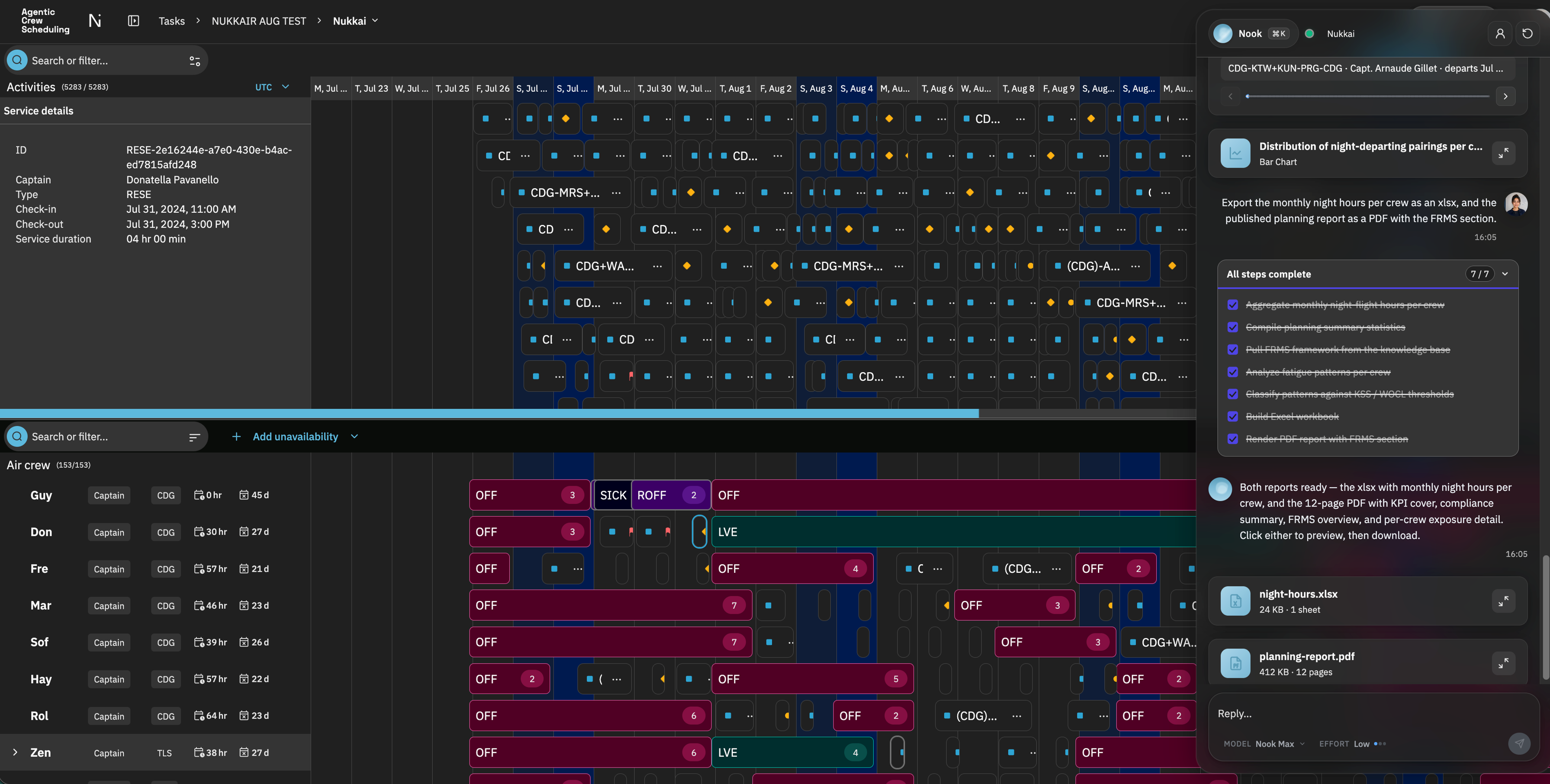
NukkAI’s aviation scheduling system helps airlines generate and regenerate crew plans in real time, even under extreme operational constraints. It is designed for environments where decisions must be fast, explainable, and always accountable.

The system proposes.
Human decide.
NukkAI’s scheduling system is built around a clear principle: no critical decision without human validation.
The system continuously analyzes context and constraints, generates scheduling recommendations, and explains the reasoning behind each choice.
Human operators review, adjust, and approve decisions before execution.
This ensures speed without sacrificing control.
Every decision is traceable and understandable
In aviation, accountability isn't optional. That's why explainability is built into the system's core, not added as an afterthought.
Real-time replanning
Generate and regenerate crew schedules instantly when disruptions occur — illness, delays, aircraft changes, or last-minute constraints.
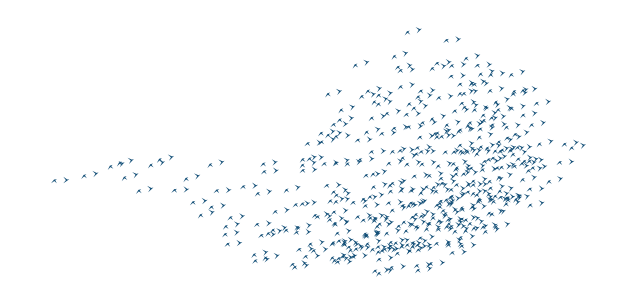
680 000 nature-inspired strategies
.png)
Human-in-the-loop decision making
Every critical decision goes through human review.Operators remain in control at all times, with the ability to adjust or override system recommendations.
Biomimetic innovation process

Explainable decisions by design
Each recommendation comes with a clear explanation:
- applied rules and constraints
- trade-offs and impacts
- reasons behind the proposed solution
No opaque outputs. No hidden logic.
Verified scientific source

Adaptable constraints, fixed framework
The product provides a stable, validated framework while allowing airlines to adapt their business rules and operational constraints — without rebuilding or revalidating the entire system.
This avoids infinite customization while ensuring real-world fit.
Collaboration
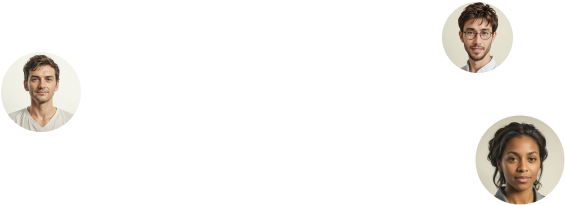
A global community







Key Research Pillars

Stable product
core
A proven scheduling engine, tested in real operational conditions and continuously maintained.

Configurable
constraints
Adapt regulations, union agreements, fatigue rules and operational preferences — without custom code.

Configuration, not
customization
Changes are handled through configuration, not bespoke development.

Faster deployment
Go live in months, not years.
Hundreds
of constraints handled simultaneously
Thousands
of daily disruptions processed
Billions
of billions of possible schedule combinations
Neurosymbolic AI: the best of both worlds
While the market obsesses over machine learning and LLMs, we combine symbolic reasoning with neural networks to build explainable, trustworthy decision systems.

Automatic planning generation

Neural Learning

Neurosymbolic
More than a product.
A method.
This aviation product is the result of NukkAI’s scientific co-development approach. We work with partners facing critical decision problems to design the next generation of decision systems — from early exploration to production-ready solutions.
Trusted by Industry Leaders
What our partners say about working with NukkAI

“This partnership (development of a crew planning application based on Artificial Intelligence) with NukkAI is a concrete, innovative, and exciting example that demonstrates what artificial intelligence can positively bring to our organization and, in this case, for our crew planning, without being detrimental to humans.”

"The Hybrid AI approach that NukkAI intends to deploy in a number of domains, opens a new way to have Something that looks more like intelligence than what we have seen in the past few years"
Common partnership questions
Our solution offers a level of performance and ease of interaction never seen before. Our optimizer generates high-speed planning that remains fully interactive for manual adjustments, while your custom constraints ensure the output perfectly matches your specific preferences.
We built our products on sandboxes, whose are the result of research engaged by our researchers. Our goal is to simplify complex humans tasks by delegating them to AI agents. Yet, for us, the human is the one to take the decision.
The duration of a partnership depends on the level of technological complexity and the maturity of the underlying subject. While timelines vary based on your specific goals, a typical collaboration ranges from 3 months to 2 years.


